Key takeaways
- Understand the importance of bottle shape in selecting the ideal Bottle Labelling Machine for your packaging needs.
- Explore various labelling options for round, flat, and double-sided bottles to achieve efficient production.
- Learn how accurate label placement and sensor control impacts retail shelf presentation and packaging efficiency.
- As a leading Bottle Labelling Machine Manufacturer in India, Liquido offers tailored solutions for diverse bottle shapes.
- Assess critical factors like production output and coding integration to optimize your labelling machine selection.
Liquido is a leading manufacturer of Bottle Labelling Machine solutions for round, flat, square, oval and other bottle formats used across industrial packaging applications.
Choosing the correct labelling system is not only about production speed. Bottle shape, label position, container stability, label dimensions and production-line requirements all influence machine selection. For B2B manufacturers, matching the labeller to the actual container and label format helps maintain consistent presentation while supporting smoother packaging operations.
Why Bottle Shape Matters in Labelling Machine Selection
Round and flat bottles behave differently when they travel through a labelling station. A cylindrical bottle may need to rotate during wrap-around label application, while a flat or rectangular bottle needs stable orientation so labels can be positioned accurately on its surfaces.
As a Bottle Labelling Machine Manufacturer, we evaluate the bottle profile and required label position before selecting the labelling arrangement. This helps determine whether the application requires vertical labelling, wrap-around labelling or simultaneous front-and-back label application.
Selecting the appropriate machine depends primarily on the bottle design and label specifications rather than production speed alone.
Labelling Options for Round Bottles
Round and cylindrical containers are commonly suited to vertical or wrap-around labelling systems. In this arrangement, the label is dispensed while the bottle is controlled so the sticker wraps around its circumference.
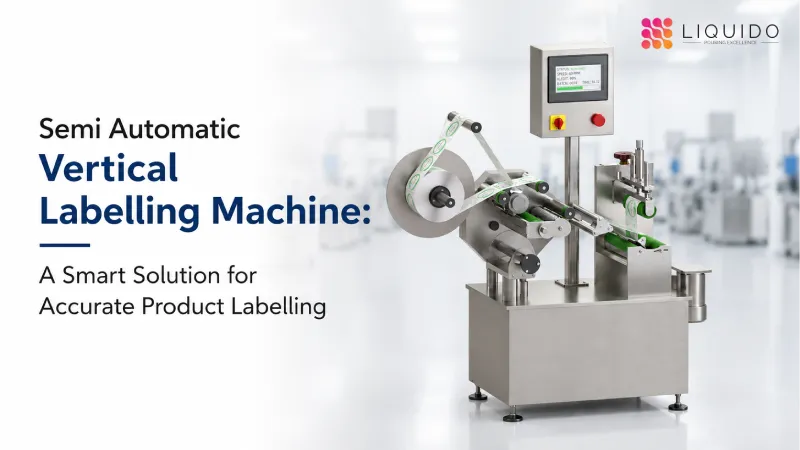
Our automatic round-bottle systems are designed for continuous conveyor-based operation, while semi-automatic vertical systems can suit smaller or medium production batches. Liquido’s current range covers both semi-automatic and fully automatic configurations for round-container applications.
When evaluating a round bottle application, buyers should check:
- Bottle diameter and height
- Label length and width
- Full-wrap or partial-wrap requirement
- Required production output
- Bottle stability during rotation
- Coding or marking requirements
These details help our team determine an appropriate machine configuration for the packaging process.
Flat, Oval and Rectangular Bottle Labelling
Flat, oval and rectangular containers generally require a different approach because the label needs to remain aligned with a defined bottle surface. Front-and-back labelling is frequently used when product information, branding or regulatory content needs to appear on opposite sides of the container.
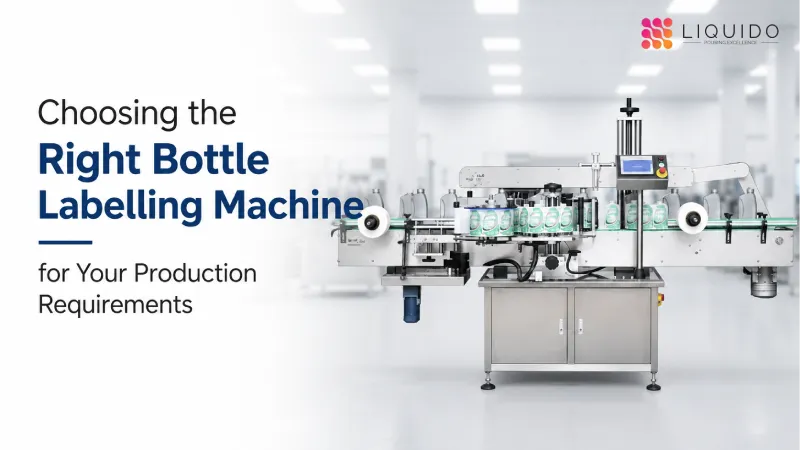
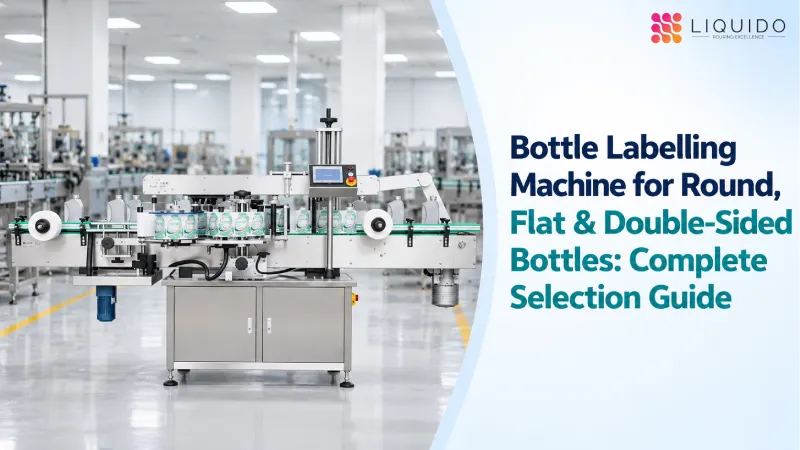
A double-sided Bottle Labelling Machine can apply front and back labels as the container moves through the conveyor. Liquido’s double-sided systems are designed for flat, oval and rectangular bottles and use sensor-based tracking to support consistent label positioning.
For B2B production environments, simultaneous front-and-back application can also reduce the need for separate labelling stages.
Round vs Flat vs Double-Sided Applications
The basic machine requirement changes according to the container and where the label needs to be applied.
| Bottle/Application | Suitable Labelling Approach | Typical Label Position | Key Selection Factor |
|---|---|---|---|
| Round bottle | Vertical or wrap-around | Around circumference | Stable bottle rotation |
| Cylindrical bottle | Automatic wrap-around | Full or partial wrap | Label alignment |
| Flat bottle | Double-sided | Front and/or back | Container orientation |
| Oval bottle | Double-sided | Front and back | Stable bottle handling |
| Rectangular bottle | Double-sided | Opposite flat panels | Accurate side positioning |
A capable Bottle Labelling Machine Manufacturer in India should therefore understand more than label dispensing alone. Bottle handling, conveyor movement, sensing and application method must work together for the specific container.
Label Placement Accuracy and Sensor Control
Accuracy in label positioning becomes particularly critical where bottles are displayed side by side in retail shelves or go into secondary packaging.
The specification of Liquido for accurate label positioning is ±1 mm during normal operating condition and good bottle handling and proper label rolls. Sensors made of fiber optic are used to detect the position of bottles and labels during operation.
These sensors play an important role in coordinating the timing of dispensing the label with respect to the moving container.
Selecting the Required Automation Level
Every manufacturer does not require the same level of automation. Factors that need to be taken into consideration include volume of production, the role of operators, and the packaging equipment in use.
The use of semi-automation may prove feasible if the bottles are manually fed into the machine and the production lots are relatively small. Fully automated equipment operates most efficiently when bottles are transported through the system using a conveyor belt.
As a Bottle Labelling Machine Manufacturer, we consider how the labelling machine will work in conjunction with other machinery.
This is even more relevant if the line also includes fillers, cap machines, coder machines, etc.
Front, Back, Top and Bottom Labelling Requirements
The bottle labels need not be limited to the front or perimeter only. There may be some cases where there is a need for labels on top, bottom or any other identification tags.
The Liquido product line offers vertical, two-side, wraparound, top side and bottom side labeling machines. It means that the self adhesive label stickers could be applied at various locations depending upon the need.
For those who are purchasing from a Bottle Labelling Machine Manufacturer in India, proper consideration of all locations for applying labels prior to purchasing will avoid limitations at a later stage.
Consider Coding Integration During Machine Selection
Packaged goods may sometimes require variable data printed along with the label printing operation.
Depending on the line setup, the coding machine may be installed before or after the labelling machine.
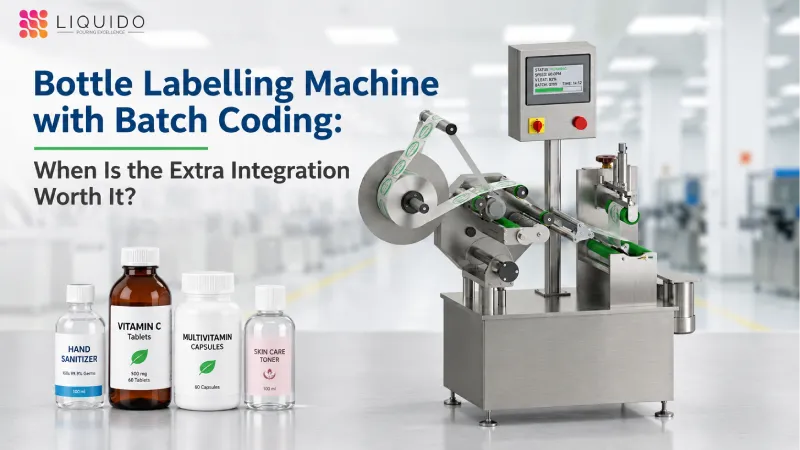
Some options that can be considered in terms of integration are CIJ/TIJ inkjet, thermal transfer, and laser coding solutions for providing batch information, manufacturing information, expiry date, barcodes, etc.
Fully automated equipment operates most efficiently when bottles are transported through the system using a conveyor belt.
Key Checks Before Finalizing a Labelling Machine
Before purchasing a machine, B2B buyers are advised to share sample bottles and detailed labeling specifications to ensure the equipment meets their requirements. This allows the configuration to be assessed around the real packaging format.
- Confirm all bottle shapes and sizes
- Define front, back, wrap, top or bottom label positions
- Check label roll and sticker dimensions
- Establish required production output
- Identify coding integration requirements
- Review conveyor height and line arrangement
- Consider future bottle-format changeovers
Working through these points with a Bottle Labelling Machine Manufacturer makes it easier to select equipment around actual production needs rather than assumptions.
Why Choose Us
We at Liquido create Automatic/ Semi-Automatic labelling solutions for varying shapes of containers and label placement. This consists of Vertical, Double-Sided, Round Bottle Wraparound, Top Side, Bottom Side machines, with sensor technology and integration with conveyors. We are Bottle Labelling Machine Manufacturers in India and ensure that we know your bottles, labels, output, and machinery before recommending a solution that fits into your packaging application as a whole.
Conclusion
Choosing the right labeling system will be based on how the bottle travels and how the machine works with the larger packaging line. Round bottles may need to be labeled using a wraparound approach while flat, oval, and rectangular bottles can be effectively labeled using a front-to-back approach. The right Bottle Labeling Machine will also have to have proper sensors and bottle handling and integration for the consistent label placement. At Liquido, our philosophy is to assess the real-life container and application for the manufacturer to select the right labeling system.
Planning a new bottle labelling line or upgrading an existing packaging setup? Contact Liquido to discuss your bottle shape, label size, required label position, production output and automation requirements.
Call: +91 98000 05293 Email: info@liquidofill.com
Speak with our team to evaluate the right labelling configuration for your packaging application.
Need help choosing the right machine?
Talk to our engineers for a configuration matched to your product and line.
Frequently asked questions
A Bottle Labelling Machine can handle various bottle shapes including round, flat, oval, rectangular, and square containers. Each type requires a different labelling approach, such as vertical labeling for cylindrical bottles and double-sided labeling for flat bottles.
Bottle shape affects how labels are applied and ensures accurate positioning during the labelling process. Different shapes, like round or flat bottles, require specific machines to maintain label alignment and production efficiency.
When selecting a Bottle Labelling Machine Manufacturer in India, consider their experience with various bottle types, the customization options available, and their understanding of your production requirements. Also, check for advanced features like sensor technology for label placement accuracy.
The level of automation in a labelling machine greatly influences production speed and efficiency. Fully automatic machines are ideal for high-volume production with seamless conveyor integration, while semi-automatic machines may suffice for smaller batches.
Key factors for ensuring label placement accuracy include bottle stability during transit, proper machine calibration, and the use of advanced sensors for tracking label position. This is crucial, especially for products displayed on retail shelves where alignment is critical.