Key takeaways
- Understanding the benefits of integrating a bottle labelling machine with batch coding can enhance operational efficiency.
- A bottle labelling machine manufacturer can help evaluate whether integration suits your specific production needs.
- Regular coding requirements may justify investing in a bottle labelling machine with integrated coding.
- Effective integration streamlines the packaging process, reducing manual handling between labelling and coding.
- Assessing bottle design and coding requirements is crucial before choosing your bottle labelling machine manufacturer in India.
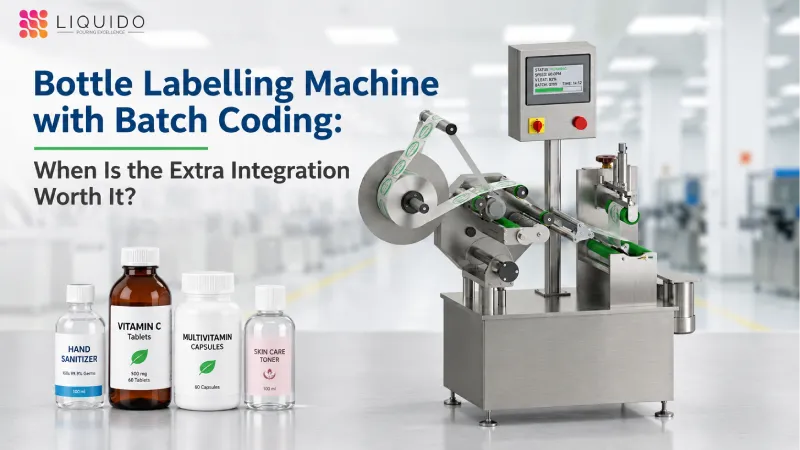
Liquido is a leading manufacturer of bottle labelling machines. A label identifies the product, while batch coding adds variable information that can be important during production and handling. When both functions are connected, bottles can move through labelling and coding as part of one coordinated process. The real question for buyers is whether this extra integration adds enough operational value to justify including it in the line.
What Does Batch Coding Integration Add?
A Bottle Labelling Machine is designed to apply labels accurately and consistently to bottles. A batch coder, on the other hand, prints changing information such as batch numbers, dates, barcodes, QR codes or other product-specific details, depending on the selected coding system.
When the coding unit is integrated into the labelling setup, these two activities can become part of the same packaging flow. Instead of treating labelling and coding as completely separate tasks, the bottle can move through a coordinated sequence.
The main value comes from connecting two routine packaging functions instead of managing them independently.
When Is the Extra Integration Worth It?
The need for integrated batch coding depends mainly on the production process. A Bottle Labelling Machine with coding becomes more useful when variable information has to be printed regularly on bottles moving through the line.
Integration may be worth considering when:
- Every batch requires changing production information.
- Batch or expiry details must be printed repeatedly.
- Your packaging process follows a continuous conveyor flow.
- You want to reduce separate manual handling between labelling and coding.
- Several products require different variable-data information.
- Coding is already part of your regular packaging sequence.
The decision should not be based only on the availability of an integrated option. Bottle shape, label location, code position, production speed and product changeovers all affect whether the arrangement makes practical sense.
How Labelling and Batch Coding Work Together
An integrated setup generally follows a simple packaging sequence. The bottle moves through the line, receives its label and then reaches the coding point at the appropriate stage.
- Bottles enter through the infeed section.
- The labelling system positions the bottle correctly.
- The label is applied to the required surface.
- A sensor or line trigger coordinates the coding operation.
- The batch or variable information is printed.
- The coded bottle continues to the next packaging stage.
A Bottle Labelling Machine Manufacturer can design the arrangement around the actual bottle movement, label position and coding requirement rather than treating the coder as an unrelated unit.
The exact setup can differ from one application to another. Good integration is about coordinating the complete process, not simply attaching a printer to a labelling machine.
Standalone Coding vs Integrated Coding
Both approaches can be practical, but they suit different production conditions.
| Factor | Standalone Coding | Integrated Coding |
|---|---|---|
| Labelling and coding | Separate operations | Connected workflow |
| Bottle movement | May involve separate handling | Primarily inline |
| Operator involvement | Can involve additional handling | Can simplify the sequence |
| Variable information | Printed as a separate step | Printed within the line |
| Best suited for | Occasional or separate coding | Regular inline coding |
For a buyer, the key question is how closely coding needs to follow the labelling operation. When both tasks happen repeatedly on the same bottles, integration can provide greater practical value.
What Should Buyers Check Before Integration?
Before selecting a Bottle Labelling Machine Manufacturer in India, it is useful to evaluate the complete packaging requirement. The labeller and coder should be considered together, especially when both units will operate in the same line.
- Bottle shape and material
- Label size and application position
- Batch, date, barcode or QR-code requirements
- Desired coding location
- Bottle spacing and line movement
- Production speed
- Product changeover frequency
- Available installation space
These checks can help buyers decide whether the additional integration is genuinely useful. They also provide the supplier with the technical information needed to recommend a suitable configuration.
When Standalone Coding May Be Better
Integration is not automatically the right answer for every packaging operation. A Bottle Labelling Machine can work perfectly well with a separate coding process when the two functions are performed at different stages.
For example, a separate arrangement may be more practical when coding is occasional, when an existing coding unit is already in place, or when the printing operation is intentionally handled away from the labelling station.
The best configuration is the one that fits the production workflow rather than the one with the most features.
This is why B2B buyers should first understand the actual process and then decide whether integration provides a meaningful operational improvement.
Choosing the Right Supplier for Integrated Labelling
The supplier plays an important role when labelling and coding need to work together. A Bottle Labelling Machine Manufacturer should understand how the bottle, label application point, conveyor movement and coding position interact during production.
For buyers comparing a Bottle Labelling Machine Manufacturer in India, the discussion should cover the actual bottle format, label specifications, coding requirements and expected production workflow. These details make it easier to determine where the coder should be positioned and how the two processes should be coordinated.
At Liquido, we focus on understanding the application before discussing the machine configuration. Our approach is to look at the packaging requirement as a complete process so that labelling and coding can be considered together when integration is appropriate.
Why Choose Us
Liquido focuses on practical packaging machinery solutions built around the production requirement. When buyers need labelling and batch coding in the same workflow, we can discuss the bottle format, label arrangement, coding position and operating needs to help identify a suitable configuration. Our focus remains on the application rather than adding unnecessary features. This gives buyers a clearer basis for deciding whether integrated coding can provide real value to their packaging operation.
Conclusion
A Bottle Labelling Machine with batch coding can be a practical choice when labelling and variable-data printing are regular parts of the same bottle packaging process. Integration can reduce separate handling and connect two important packaging stages into one coordinated flow. However, it is not automatically necessary for every production setup. The right decision depends on bottle design, label placement, coding requirements, production movement and changeover needs. Working with a capable Bottle Labelling Machine Manufacturer in India can help you evaluate these factors before selecting the final configuration. Liquido can help you assess whether integrated labelling and batch coding are suitable for your application.
Ready to evaluate an integrated bottle labelling and batch-coding setup? Contact Liquido to discuss your bottle, label and coding requirements and identify a suitable machine configuration for your production line. Call +91 98000 05293 or email info@liquidofill.com for a direct discussion with our team.
Need help choosing the right machine?
Talk to our engineers for a configuration matched to your product and line.
Frequently asked questions
An integrated Bottle Labelling Machine with batch coding streamlines the packaging process by connecting the labelling and coding stages. This coordination minimizes the need for separate handling, enhancing production efficiency and accuracy, especially for products that require variable information like batch numbers or expiry dates.
Consider an integrated system when your production process regularly requires changing variable data on bottles, such as batch or expiration dates. Additionally, if your packaging line operates continuously or if you aim to reduce manual handling, integration could provide significant operational value.
Standalone coding treats labelling and coding as separate operations, which may involve additional handling and processing time. In contrast, integrated coding creates a connected workflow where bottles are labelled and coded in a seamless inline process, minimizing delays and improving overall productivity.
Before making a choice, assess factors such as bottle shape, label size, coding requirements, production speed, and the frequency of product changeovers. These considerations will help ensure that the manufacturer you choose can customize a solution that fits your unique packaging needs.
Yes, integrating a Bottle Labelling Machine with existing coding equipment can be done if the two systems can work together effectively. Discussing the bottle format, label placement, and coding position with a knowledgeable manufacturer will help ensure a suitable configuration is achieved.