Key takeaways
- Evaluate bottle and cap compatibility to ensure efficient operation of your Fully Automatic Bottle Capping Machine.
- Check torque control settings to prevent issues with loose or overtightened caps during high-speed bottling.
- Consider changeover requirements for different bottle and cap sizes when selecting an automatic capping machine.
- Discuss your complete bottling line layout with a Fully Automatic Bottle Capping Machine Manufacturer in India for optimal integration.
- Stable cap feeding systems are essential for consistent capping performance in high-speed packaging lines.
Liquido is a leading manufacturer of Fully Automatic Bottle Capping Machine solutions for high-speed and integrated bottling applications.
When production volumes increase, capping cannot become the stage that slows the entire packaging line. Buyers need to evaluate much more than advertised machine speed. The efficiency of an automatic capping machine during continuous production depends on several factors, including cap compatibility, precise torque adjustment, smooth bottle movement, ease of product changeover, and proper synchronization with the product
Start With Your Bottle and Closure Combination
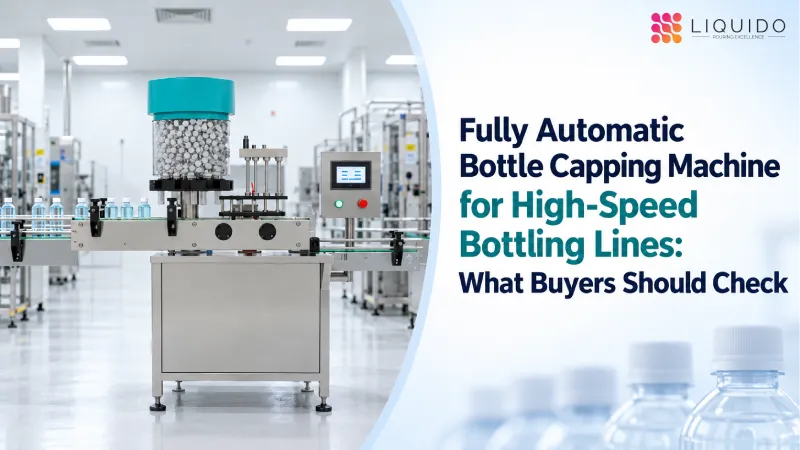
The key consideration is selecting the appropriate bottle and cap types to ensure the machine operates efficiently and reliably. A Fully Automatic Bottle Capping Machine must be configured according to closure style, bottle neck, cap dimensions and container stability.
Different closures require different handling and application methods. Screw caps require controlled rotational tightening, while press-on or snap closures depend on controlled downward force. ROPP closures use a different closing mechanism again.
Before approaching a Fully Automatic Bottle Capping Machine Manufacturer, buyers should prepare actual bottle and closure samples whenever possible. This allows the machine configuration to be based on the real packaging format rather than assumptions.
Check Whether the Capping System Matches Your Cap Type
Modern production lines may handle several closure designs depending on the product category. At Liquido, our capping solutions can be configured for closure types such as screw caps, ROPP caps, press-on caps, snap caps, CRC caps, trigger sprayers and pumps.
Buyers should verify:
- Cap type and material
- Cap diameter and height
- Bottle neck dimensions
- Required tightening method
- Bottle shape and stability
- Number of bottle and cap formats planned
These details help determine the appropriate feeding, placement and capping mechanism.
Evaluate Torque Control, Not Just Machine Speed
High output has limited value if caps are repeatedly loose, overtightened or damaged. Controlled torque is therefore one of the most important factors when selecting automatic screw-capping equipment.
A suitable Fully Automatic Bottle Capping Machine should apply repeatable tightening force according to the closure requirement. Depending on the application, capping systems can use technologies such as magnetic-clutch or servo-controlled torque heads.
Consistent torque matters because high-speed production increases the impact of even small variations repeated across large batches.
When discussing requirements with a Fully Automatic Bottle Capping Machine Manufacturer in India, buyers should clearly communicate the closure specification and expected tightening requirement instead of evaluating output speed alone.
Match Machine Capacity With the Complete Bottling Line
A capper should not be selected as an isolated machine. Its practical output needs to work with the filler, conveyor, labelling equipment and other downstream packaging systems.
The basic production flow typically involves:
- Filled bottles enter the capping section through the conveyor.
- Caps are fed and correctly oriented.
- The closure is positioned onto the bottle.
- The capping mechanism applies the required closing action.
- Capped bottles exit toward labelling or further packaging.
If the filler sends bottles faster than the capper can process them, accumulation can occur. If the capper is considerably faster than surrounding equipment, its available capacity may not provide a practical advantage.
A capable Fully Automatic Bottle Capping Machine Manufacturer should therefore consider the complete line requirement rather than recommending equipment purely on standalone speed.
Look Closely at Cap Feeding and Orientation
Automatic capping depends on more than the capping head. Bottle caps must also be accurately aligned and consistently positioned before being placed onto the bottles.
Cap-feeding arrangements commonly involve a feeding and orientation system that presents closures correctly before placement. An improper cap-feeding system may result in missing or misaligned caps, leading to disruptions in continuous production operations.
For high-speed lines, stable cap feeding is directly connected to stable capping performance. Buyers should discuss cap geometry, cap behavior and feeding requirements during machine selection.
Consider Changeover Requirements
Many manufacturers run more than one bottle or cap size on the same packaging line. In such cases, changeover requirements become a major purchasing consideration.
The right Fully Automatic Bottle Capping Machine should be selected with the planned range of packaging formats in mind. Buyers should understand which components require adjustment or replacement when moving between bottle or closure sizes.
When evaluating suppliers, ask how changes in bottle diameter, height, cap dimensions or closure style affect setup. This information enables production teams to assess how effectively the machine can be integrated into routine manufacturing operations, rather than relying solely on its performance during a demonstration involving a single product.
Check Line Integration and Automation Capability
High-speed packaging requires synchronized machinery. The height of the conveyor, distance between bottles, sensors, machinery control, and upstream-downstream coordination may affect the performance of the entire line.
At Liquido, we manufacture both independent packaging machines and filling, capping and labeling machines connected to the conveyor system. Compatibility with the line is thus crucial in choosing the machines.
While Choosing a Fully Automatic Bottle Capping Machine Manufacturer in India, buyers must talk about the layout of their line, available space, arrangement of conveyor and possible upstream or downstream machines.
What Buyers Should Verify Before Ordering
Machine selection becomes easier when technical requirements are documented before discussions with suppliers.
- Actual bottle and cap samples
- Closure type and dimensions
- Required production output
- Required torque or closure method
- Number of packaging formats
- Existing conveyor specifications
- Filling and labelling machine compatibility
Sharing these details with a Fully Automatic Bottle Capping Machine Manufacturer helps both sides define the application more accurately and reduces uncertainty during engineering and commissioning.
Why Choose Us
For Liquido, we design the machines based on the real needs of the customer, which include his bottle, closure, and production needs rather than capping being seen as a stand-alone task. We deal with the manufacturing firms from different industries including pharmaceuticals, foods and beverages, cosmetics, chemicals, and other industries involved in packaging. We are Fully Automatic Bottle Capping Machine Manufacturers in India and we ensure that the machines function well together with other machinery such as filling and labeling equipment.
Conclusion
Choosing the correct automatic capper for a high-speed bottling line is not just about considering the machine’s throughput. The buyer needs to consider the compatibility of the closure, the handling of the bottles, torque control, cap feeding, and even format changes and how well it fits into the rest of the machinery around it. It can be useful to work with a reputable Fully Automatic Bottle Capping Machine Manufacturer from India in order to ensure that the right machine configuration is chosen for the real production scenario.
Planning a high-speed bottling line or upgrading your existing capping process? Contact Liquido with your bottle samples, cap specifications and required production output. Our team can help you identify a suitable automatic capping configuration for your application.
Call: +91 98000 05293 Email: info@liquidofill.com .
Talk to our team today about a fully automatic bottle capping solution built around your packaging requirements.
Need help choosing the right machine?
Talk to our engineers for a configuration matched to your product and line.
Frequently asked questions
When choosing a Fully Automatic Bottle Capping Machine, consider crucial factors such as cap compatibility, torque control, bottle stability, and the machine's synchronization with the entire production line. Ensure that the machine's configuration aligns with the specific types of bottles and closures you plan to use.
The type of cap directly influences how a Fully Automatic Bottle Capping Machine operates. Different closures require unique handling methods; for instance, screw caps need rotational tightening while press-on caps use downward force. It's vital to match the machine's capabilities with the cap characteristics for efficient operation.
Before contacting a Fully Automatic Bottle Capping Machine Manufacturer, gather actual samples of your bottles and caps, and document key specifications like closure type, dimensions, production output, and compatibility with existing equipment. This information will facilitate more accurate discussions about your needs.
Torque control is essential in a Fully Automatic Bottle Capping Machine because it ensures that caps are securely fastened without being overtightened or damaged. Consistent torque application helps maintain high-quality capping across large production batches and reduces the risk of operational issues.
To ensure seamless integration of your Fully Automatic Bottle Capping Machine with your production line, discuss with manufacturers about the layout, available space, and arrangement of other machinery, such as fillers and labelers. Understanding the coordination and synchronization requirements is crucial for maintaining efficiency in high-speed operations.