Key takeaways
- Automatic bottle capping machines require less manual handling and integrate seamlessly into continuous production lines.
- Semi-automatic bottle capping machines involve operator assistance and are ideal for changing production environments.
- Choosing the right capping machine depends on bottle specifications, production workflow, and operator involvement.
- Consulting a reliable bottle capping machine manufacturer can help evaluate your specific capping needs and operational requirements.
- Automation level directly impacts efficiency in packaging workflows, with automatic machines minimizing manual tasks while semi-automatic machines maintain operator control.
Liquido is a leading manufacturer of bottle capping and liquid packaging machinery. Choosing between an automatic and semi-automatic Bottle Capping Machine can affect your packaging workflow, labour requirements, and production setup. Both systems perform the basic job of securing caps on bottles, but their operation and level of automation are different.
What Is an Automatic Bottle Capping Machine?
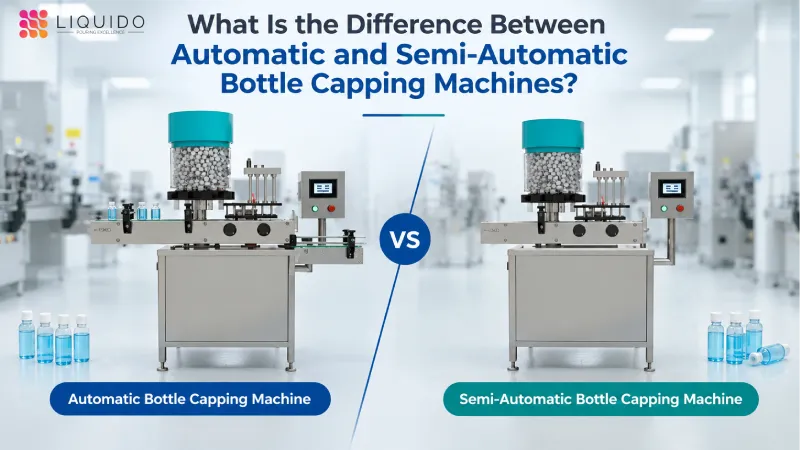
An automatic Bottle Capping Machine is designed to perform the capping operation with minimal manual intervention. Bottles can move through the machine as part of a continuous packaging process, while cap feeding, placement, and tightening are handled by the automated system according to the machine configuration.
This type of machine is generally considered when a production line needs a continuous and consistent capping process. It can also be integrated with other packaging equipment where the bottle moves from one stage to another without requiring an operator to manually handle every bottle.
At Liquido, we develop packaging machinery with practical automation in mind, helping businesses select equipment according to their actual production requirements rather than treating every application the same way.
What Is a Semi-Automatic Bottle Capping Machine?
A semi-automatic Bottle Capping Machine combines machine-assisted capping with some manual handling. Depending on the design, an operator may need to place bottles, position caps, or feed containers into the capping station before the machine completes the tightening operation.
This arrangement can be useful where production requirements do not justify a fully automatic line or where operators are already involved in other packaging activities. It provides mechanical assistance while keeping part of the process under human control. The main difference, therefore, is not the purpose of the machine but how much of the capping process is automated.
Automatic vs Semi-Automatic: Key Differences
The following comparison makes the distinction easier for B2B buyers evaluating packaging equipment.
| Criteria | Automatic Capping Machine | Semi-Automatic Capping Machine |
|---|---|---|
| Bottle handling | Mostly automated | Partly manual |
| Operator involvement | Lower | Higher |
| Production workflow | Suitable for continuous lines | Suitable for assisted operations |
| Integration | Can be integrated with packaging lines | Often used as a standalone or assisted station |
| Process control | More automated | More operator-dependent |
The right choice depends on bottle handling requirements, production workflow, available labour, and whether the machine needs to work as part of a broader packaging line.
How Does the Level of Automation Affect Production?
The biggest practical difference between the two systems is operator involvement. With a semi-automatic setup, employees remain involved in handling bottles or caps during the process.
With an automatic machine, more of these activities can be performed by the equipment. This can make the overall workflow more suitable for continuous packaging operations where manual handling at every bottle would interrupt the process.
Automation should be selected according to the complete production workflow, not simply the desired machine type.A Bottle Capping Machine Manufacturer can help evaluate the bottle, cap, production arrangement, and available line equipment before recommending a configuration.
Which Machine Offers Better Flexibility?
Flexibility depends largely on the application. Semi-automatic systems can be practical when production involves operator-controlled handling or when the packaging setup changes regularly.
Automatic systems can provide a more structured workflow when bottles need to travel continuously through connected equipment. They are particularly relevant when capping is one stage of a larger automated packaging process.
At Liquido, we focus on building filling, capping, and labelling systems that can be adapted to the operational needs of different packaging applications.
What Should B2B Buyers Consider Before Choosing?
Before selecting a capping system, buyers should look beyond the word “automatic.” The actual requirement depends on the production environment and the way bottles and caps are handled.
Consider these points:
- Bottle shape, size, and neck configuration
- Type and design of cap
- Required level of operator involvement
- Whether the machine will operate independently or within a packaging line
- Existing filling, labelling, or conveyor equipment
- Future production requirements
A reliable Bottle Capping Machine Manufacturer should discuss these factors before finalising the machine configuration.
When Is a Semi-Automatic Machine More Suitable?
A semi-automatic machine may be a practical choice when the packaging process still involves significant manual handling. For example, businesses with operator-assisted workflows may prefer a system that mechanises the tightening operation without completely changing the way bottles are handled.
It can also make sense where the capping station is required independently rather than as part of a fully integrated packaging line.
The important point is to match automation with actual operational requirements. Buying a higher level of automation than the process needs can make the setup unnecessarily complicated, while insufficient automation may create avoidable manual work.
When Is an Automatic Machine More Suitable?
An automatic system becomes more relevant when the goal is to reduce repeated manual handling and connect capping with a continuous packaging process.
For businesses using filling, capping, and labelling equipment together, automation can help create a smoother movement of bottles between different stages. Liquido works with packaging machinery covering filling, capping, and labelling applications, allowing equipment requirements to be considered as part of the broader workflow.
A Bottle Capping Machine Manufacturer in India can assess whether automatic capping is appropriate based on the complete production setup rather than on capping alone.
How Do You Choose Between the Two?
A simple decision process can help narrow down the right option:
- Review your bottle and cap specifications. The container and closure combination determines the appropriate capping arrangement.
- Assess operator involvement. Decide how much manual handling your current process requires.
- Review the production workflow. Check whether capping needs to operate independently or alongside other machinery.
- Consider future requirements. Think about whether production is likely to become more automated over time.
- Discuss the application with the manufacturer. A machine should be selected around the actual process rather than only the machine category.
For buyers searching for a Bottle Capping Machine Manufacturer in India, application-focused guidance is especially important because the same automation level may not suit every packaging operation.
Why Choose Us
Liquido specialises in machinery for filling, capping, and labelling applications, with a focus on practical machine design and production-line requirements. We work with customers to understand their packaging needs and develop equipment around the intended workflow. Our approach is to keep automation useful and straightforward while considering how the capping machine fits with the rest of the packaging process.
Conclusion
Automatic and semi-automatic capping machines both have an important role in bottle packaging, but they suit different operating conditions. A semi-automatic system keeps the operator involved, while an automatic machine takes over more of the repetitive capping workflow. Your decision should be based on bottle and cap specifications, production flow, labour involvement, and integration requirements. Working with an experienced Bottle Capping Machine Manufacturer in India can make the selection process more practical and application focused. Liquido can help businesses evaluate their capping requirements and select a suitable machine configuration for their packaging workflow.
Ready to select the right capping solution for your production line? Speak with Liquido, your trusted Bottle Capping Machine Manufacturer, to discuss your bottle, cap, and automation requirements. Call: +91 98000 05293 Email: info@liquidofill.com .
Need help choosing the right machine?
Talk to our engineers for a configuration matched to your product and line.
Frequently asked questions
The main difference lies in the level of automation. An automatic Bottle Capping Machine requires minimal manual intervention, allowing for continuous capping in a production line, while a semi-automatic machine involves some manual handling by operators during the capping process..
An automatic machine is recommended when the production goal is to minimize manual handling and achieve a smooth, continuous workflow across multiple stages of packaging. This is ideal for businesses that integrate filling, capping, and labelling processes.
In automatic capping machines, operator involvement is significantly lower as the machine handles most tasks autonomously. In contrast, semi-automatic machines require operators to assist with aspects like bottle placement and cap feeding.
Buyers should evaluate bottle and cap specifications, required levels of operator involvement, and whether the machine will operate independently or within a packaging line. It's also essential to consider future production requirements and the overall workflow.
Yes, a reliable Bottle Capping Machine Manufacturer can assist businesses by evaluating their specific needs, including the bottle shape, cap type, and production setup. This tailored approach ensures that the chosen machine configuration aligns with actual operational requirements.