Key takeaways
- Automatic Bottle Capping Machines ensure consistent closure, reducing risks of loose caps and product leaks.
- Controlled torque application in automatic capping helps maintain appropriate tightening levels for all bottles.
- Incorporating automation in capping improves production flow and decreases packaging rejections significantly.
- Choose the right Automatic Bottle Capping Machine based on specific bottle and closure requirements to enhance packaging quality.
- Automated systems offer repeatability and efficiency, minimizing manual handling during the packaging process.
Liquido is a leading manufacturer of Automatic Bottle Capping Machine solutions for reliable bottle closure and packaging applications.
A cap may look like a small part of the packaging process, but inconsistent tightening can lead to loose closures, product leakage, damaged caps and rejected packs. For B2B manufacturers running repetitive production, reliable capping is therefore a critical part of packaging quality. Our automated capping systems ensure precise torque control and uniform cap placement, with seamless integration into existing production lines for efficient and reliable operation.
Why Loose Caps Become a Serious Packaging Problem
A loose cap can develop when the closure is not tightened sufficiently or when the capping process varies from bottle to bottle. In manual operations, differences in operator pressure, positioning and handling can make consistent tightening difficult during continuous production.
At Liquido, we focus on controlled cap application because consistent closing force is one of the most important factors in maintaining reliable bottle sealing. An automated system keeps the capping process repeatable rather than depending heavily on individual operator technique.
Loose or incorrectly applied closures can contribute to several packaging issues:
- Product leakage during handling or transportation
- Caps becoming loose after packing
- Uneven or tilted cap placement
- Closure damage caused by excessive tightening
- Bottles being rejected during quality inspection
- Additional rework and manual checking
Reducing these variations helps manufacturers create a more controlled packaging operation.
How Controlled Torque Helps Prevent Loose or Damaged Caps
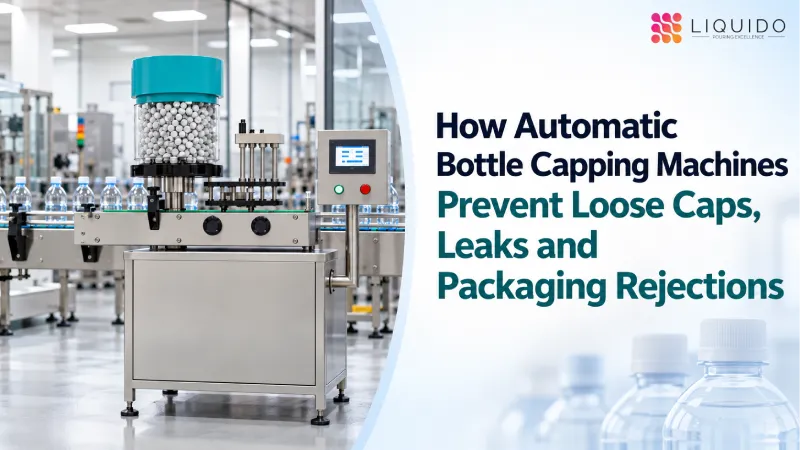
One of the key functions of an Automatic Bottle Capping Machine is applying caps with controlled torque. Torque refers to the rotational force used when tightening a closure.
Too little torque can leave a cap loose. Excessive torque can damage the cap, closure thread or container. A controlled capping mechanism helps maintain a suitable tightening level across bottles moving through the line.
Our capping machines offer adjustable torque settings based on the specific machine configuration selected. This gives manufacturers better control over cap tightening for the bottle and closure being handled.
The objective is not simply to tighten a cap as much as possible; it is to apply repeatable and appropriate tightening force.
How Automatic Capping Reduces Leakage Risk
A properly positioned and tightened closure forms an important part of protecting the packaged product. When the cap is misaligned, cross-threaded or insufficiently tightened, the closure may not sit correctly on the container.
An automatic capping process typically follows a controlled sequence:
- Bottles move into the capping area through the production line.
- The closure is presented or positioned for capping.
- The bottle is stabilized for accurate cap application.
- The capping head engages the closure.
- Controlled torque is applied to tighten the cap.
- The sealed bottle is then transferred to the subsequent phase of the packaging process.
By repeating the same sequence bottle after bottle, the Automatic Bottle Capping Machine reduces variations commonly associated with repetitive manual capping.
Preventing Packaging Rejections Through Consistency
Packaging rejection is not caused only by a missing cap. A bottle may also be rejected because the closure is tilted, loose, damaged or improperly seated.
For production teams, these defects can create rework and interrupt downstream packaging activities. Automated capping provides a more consistent process by coordinating bottle movement, cap application and tightening.
Liquido offers capping solutions suitable for different closure requirements, including screw caps, ROPP aluminium caps, press-on caps, snap caps, CRC caps, trigger sprayers and pumps.
This flexibility matters because each closure style has its own application requirements. Choosing a capping method suited to the actual container and cap combination helps improve packaging consistency.
Manual Capping vs Automatic Bottle Capping
The practical distinctions between the two methods become more evident when evaluated against the same production-related parameters.
| Criteria | Manual Capping | Automatic Capping |
|---|---|---|
| Tightening | Depends more on operator handling | Controlled capping mechanism |
| Repeatability | Can vary between operators | Designed for repetitive operation |
| Production flow | Requires continuous manual involvement | Integrates with automated production |
| Torque control | Difficult to repeat consistently | Adjustable depending on configuration |
| High-volume suitability | Limited by manual handling | Better suited to continuous production |
For manufacturers increasing production volumes, automation can reduce dependence on repetitive manual closure application while maintaining a more uniform capping process.
Selecting the Right Capping System for Your Bottle and Cap
A machine should be selected around the actual packaging requirement rather than simply around production speed. Machine configuration depends on several factors, including the bottle’s shape, type of closure, cap size, tightening torque requirements, and layout of the production line.
Before selecting an Automatic Bottle Capping Machine, B2B buyers should verify:
- Bottle material, diameter and height
- Cap type and closure dimensions
- Required capping torque
- Desired production output
- Existing conveyor and line arrangement
- Changeover requirements for multiple formats
- Upstream filling and downstream packaging compatibility
Our team at Liquido works with customers to understand these production variables before recommending an appropriate capping configuration.
Integration Matters as Much as Capping Performance
The capping machine usually functions in conjunction with a series of other packaging processes, unlike being an individual machine on its own. Bottles should be able to move in sequence from the filling stage through capping and even towards labeling and other subsequent processes.
An integrated capping machine will enable continuous movement of bottles and avoid unnecessary human handling in between the processes. Line integration becomes critical where production capacity requires coordination among several machines.
For companies looking for a full packaging line, the consideration of conveyor synchronization and compatibility becomes just as important as that of the capping head.
Why Choose Us
The way we look at bottle capping at Liquido is that it is one of the key elements in packaging in its entirety. Our capping machines are designed with the idea of controlling the tightness, closure and integration with other filling and packaging lines. We can cater to many different bottle and closure applications such as screw closures, ROPP, press, snap, CRC, trigger spray and pump closures. We understand that our client needs to get the exact machine for his application.
Conclusion
Loose lids, leakage, and packing rejections are often associated with the issue of consistency of lid placement or tightening. Transitioning from a manually repetitive process of lid placement to the use of an Automatic Bottle Capping Machine is likely to result in a greater level of consistency in lid placement, better torque adjustment and performance. An appropriate machine has to be chosen based on the specific bottle, lid type and other considerations.
Looking for a reliable automatic bottle capping solution for your production line? Contact Liquido to discuss your bottle type, closure, production requirements and packaging-line configuration with our team.
Call: +91 98000 05293 Email: info@liquidofill.com
Speak with our team today to identify a capping configuration suited to your manufacturing and packaging requirements.
Need help choosing the right machine?
Talk to our engineers for a configuration matched to your product and line.
Frequently asked questions
An Automatic Bottle Capping Machine ensures consistent tightening and precise torque control, which helps prevent loose caps and product leakage. This reliability ultimately reduces packaging rejections and enhances overall packaging quality, making it essential for high-volume production.
By maintaining controlled torque during the capping process, an Automatic Bottle Capping Machine ensures that caps are applied correctly and securely. This reduces the risk of misalignment, cross-threading, and insufficient tightening, which are common causes of leaks.
When choosing an Automatic Bottle Capping Machine, consider the bottle material, cap type, required capping torque, and production output. Additionally, assess the layout of the production line and compatibility with upstream filling and downstream packaging processes.
Automated capping reduces variations associated with manual processes by using a controlled mechanism for cap placement and tightening. This repeatability ensures uniform application across all bottles, which minimizes the risk of cosmetic defects that can lead to packaging rejections.
Yes, Automatic Bottle Capping Machines can be configured to accommodate various types of closures, including screw caps, ROPP caps, and snap caps, among others. This versatility allows manufacturers to choose a machine that best fits their specific closure requirements.