Key takeaways
- Understanding liquid viscosity is crucial for selecting the right Liquid Filling Machine for accurate and efficient packaging.
- A professional Liquid Filling Machine Manufacturer in India can customize solutions based on your product's unique viscosity.
- Choose filling technology based on actual product testing rather than just viscosity classifications for optimal filling performance.
- Always consider fill volume, production speed, and nozzle design alongside liquid viscosity when selecting a filling machine.
- Understand liquid viscosity to choose the right Liquid Filling Machine for optimal performance.
Liquido is a leading Liquid Filling Machine Manufacturer in India offering filling solutions for thin, semi-viscous, and highly viscous liquid products.
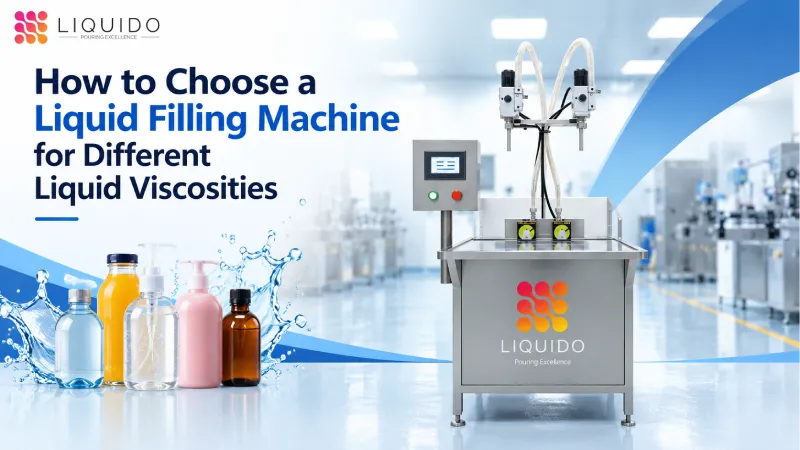
Choosing the right Liquid Filling Machine starts with understanding how the product behaves during transfer and dispensing. Water-like liquids, oils, syrups, creams, sauces, and lubricants do not flow in the same way, so they should not automatically be filled using the same technology. For B2B buyers, matching the filling principle to product viscosity can improve filling consistency, line efficiency, and overall packaging quality.
Why Liquid Viscosity Matters When Selecting a Filling Machine
Viscosity describes how easily or slowly a liquid flows. A low-viscosity liquid moves quickly, while a high-viscosity product flows more slowly and may require greater control during dispensing.
This difference directly affects nozzle design, dosing method, filling speed, drip control, and machine configuration.
A suitable Liquid Filling Machine should therefore be selected around the product itself rather than only around bottle size or desired production output.
The more accurately the filling principle matches the liquid’s flow characteristics, the more stable the filling process becomes.
Choosing a Machine for Low-Viscosity Liquids
Low-viscosity products are generally free-flowing and can move quickly through pipelines and filling nozzles. Typical examples include water-like solutions, sanitisers, light chemicals, some pharmaceutical liquids, and other thin products.
For these applications, flow-meter, time-pressure, gravity, or other controlled volumetric technologies may be suitable depending on the required filling accuracy, product properties, and production setup.
A professional Liquid Filling Machine Manufacturer will normally evaluate factors such as:
- Product flow behaviour
- Required fill volume
- Bottle neck dimensions
- Foaming tendency
- Target production speed
- Required level of automation
For fast-flowing liquids, nozzle shut-off and dosing control are especially important because uncontrolled flow can contribute to dripping or overfilling.
Choosing a Machine for Medium-Viscosity Liquids
Products such as syrups, edible oils, lotions, and some personal-care liquids sit between very thin and highly viscous products.
These liquids need greater control because their flow characteristics may change with temperature, formulation, or product composition.
Depending on the application, volumetric piston, servo-controlled, or flow-meter configurations can be considered. Liquido manufactures filling systems designed to handle a wide range of liquid viscosities, with the filling principle selected according to the product and production requirement.
For medium-viscosity products, buyers should look closely at fill repeatability, nozzle design, and changeover flexibility.
Choosing a Machine for High-Viscosity Liquids
Thicker products such as creams, gels, heavy sauces, lubricants, and certain cosmetic formulations require a filling system capable of moving dense products consistently.
A piston-based system is often suitable because the piston can positively displace a measured quantity of product rather than relying mainly on free flow.
When selecting a Liquid Filling Machine for a viscous product, check the following points:
- Whether the product contains particulates
- Whether viscosity changes with temperature
- Required fill volume per container
- Nozzle diameter and anti-drip design
- Product-contact material requirements
- Cleaning and changeover expectations
- Required bottles per minute
These details help determine whether a standard configuration is suitable or whether the machine should be customized.
Comparing Filling Technologies by Viscosity
The table below provides a practical overview of how different filling principles can suit different product behaviours.
| Filling Principle | Typical Product Behaviour | Common Applications | Key Selection Consideration |
|---|---|---|---|
| Gravity Filling | Thin, free flowing | Water-like liquids | Flow consistency |
| Flow Meter Filling | Thin to medium viscosity | Oils, chemicals, beverages | Accurate flow measurement |
| Volumetric Piston | Medium to high viscosity | Syrups, creams, sauces | Positive product displacement |
| Servo Piston | Medium to high viscosity | Cosmetics, pharma, lubricants | Precise programmable dosing |
| Peristaltic Filling | Thin, sensitive liquids | Pharma and specialty fluids | Controlled product contact |
The final selection should always be based on actual product testing and application requirements rather than on viscosity classification alone.
Consider Fill Volume and Production Speed Together
Viscosity is important, but it should not be considered in isolation. Fill volume and production output also influence machine configuration.
Liquido’s liquid filling systems cover applications from small-volume filling to larger container formats, with standard systems listed from 5 ml to 5 L per cycle and larger filling formats available on request. Depending on the machine and configuration, production capacity can range from semi-automatic operation to high-speed multi-head automatic filling.
A reliable Liquid Filling Machine Manufacturer in India should therefore evaluate product viscosity together with container size, target speed, filling accuracy, and the number of filling heads required.
Evaluate Nozzle Design and Drip Control
The filling nozzle plays a major role in packaging quality, particularly when working with foaming, stringy, or viscous liquids.
For sensitive applications, bottom-up filling and positive shut-off nozzle designs can help control product flow and reduce dripping. On automatic systems, no-bottle-no-fill controls can also prevent unnecessary product discharge when a container is missing or incorrectly positioned.
Good nozzle selection can be just as important as choosing the filling technology itself.
This is particularly relevant when clean bottle necks are required before capping and labelling.
Check Cleaning and Product-Contact Requirements
Different industries have different expectations for cleaning, hygiene, and product-contact materials.
Food, pharmaceutical, cosmetic, lubricant, and chemical applications may require different machine construction and wetted-part materials. Liquido offers SS 304 and SS 316L product-contact options depending on the application and machine configuration.
When speaking with a Liquid Filling Machine Manufacturer, buyers should clearly communicate product chemistry, cleaning method, and industry requirements before machine selection.
Why Choose Us
At Liquido, we evaluate filling applications based on the product, viscosity, container, fill volume, required output, and line arrangement rather than recommending a single filling method for every liquid. As an experienced Liquid Filling Machine Manufacturer in India, we offer volumetric, piston, flow-meter, peristaltic, and servo-based filling solutions for different production requirements. Our team works with customers across pharmaceutical, food, cosmetic, chemical, lubricant, and other liquid-packaging applications to configure filling systems around actual production needs.
Conclusion
Choosing the right filling equipment begins with understanding how your liquid behaves. Thin liquids generally require fast and controlled flow management, while medium and high-viscosity products may benefit from piston or servo-based dosing. Bottle size, fill volume, nozzle design, production speed, cleaning requirements, and product-contact materials should also be considered before finalizing a Liquid Filling Machine. Working with a capable Liquid Filling Machine Manufacturer helps align the filling principle with both product characteristics and production goals, creating a more controlled and practical packaging process.
Looking for the right filling solution for your liquid, oil, syrup, cream, chemical, or other flowable product?
Contact Liquido and share your product viscosity, fill volume, bottle size, and required production output. Our team can help you identify a machine configuration suited to your packaging application.
Call: +91 98000 05293
Email: info@liquidofill.com
Need help choosing the right machine?
Talk to our engineers for a configuration matched to your product and line.
Frequently asked questions
Selecting the right Liquid Filling Machine starts with understanding the flow characteristics of your liquid. For thin products, consider technologies like gravity or flow-meter filling, while thicker liquids may require piston-based systems. Evaluate factors such as fill volume, bottle neck dimensions, and production speed.
For low-viscosity liquids like water or sanitisers, gravity filling, flow-meter, and time-pressure methods are effective. These technologies ensure fast and controlled flow, which is crucial for maintaining filling accuracy and preventing overfilling.
Viscosity affects how easily a liquid flows, influencing the choice of filling technology. A suitable machine must match the liquid's flow characteristics to ensure consistent filling and high packaging quality.
Look for a manufacturer that evaluates your specific needs, including product viscosity, fill volume, and automation requirements. An experienced Liquid Filling Machine Manufacturer will guide you through selecting the appropriate technology for your application.
Nozzle design is critical, especially for foaming or viscous liquids, as it directly impacts packaging quality. Features like bottom-up filling and anti-drip mechanisms help control flow and minimize waste, making the filling process more efficient.